Industrial AI

Edge vs. Cloud AI in Manufacturing: A Strategic Architectural Guide

Choosing between Edge and Cloud for manufacturing AI is a critical architectural decision. This guide outlines a hybrid framework where Edge manages real-time 'reflexes' and Cloud orchestrates strategic intelligence.

By Dr. Shiney Jeyaraj6 min read
Edge AICloud AIIndustrial AIManufacturingHybrid Architecture

Edge vs. Cloud AI in Manufacturing: A Strategic Architectural Guide

At a Glance: The Nervous System of Smart Manufacturing

  • The Decision: Choosing between Edge and Cloud AI is a critical architectural choice balancing latency, cost, and connectivity.
  • The Framework: Edge handles real-time, time-sensitive "reflexes" while Cloud orchestrates long-term analytical reasoning.
  • The Gold Standard: Hybrid AI that "Senses at the Edge and Learns in the Cloud."
  • The Result: Production resilience, security, global scalability, and reduced unplanned downtime.

The Opening Scene: The Split-Second That Costs a Million Dollars

Picture this.

It's 3:17 AM on a Tuesday. A CNC spindle in your flagship factory is running at 22,000 RPM. A microscopic thermal anomaly begins—0.3 degrees above baseline. Nothing dramatic. Nothing a human would notice.

But in 47 seconds, that spindle will seize.

The tool will shatter.

Three hundred parts will go to scrap.

Your 6 AM shipment window will close.

Now ask yourself: Where should the intelligence that prevents this disaster live?

In the Cloud, 800 miles away, waiting for a network packet?

Or on the machine itself, watching every millisecond?

This is the Edge vs. Cloud question. And your answer will define your factory's future.


The Architecture: Your Factory as a Human Nervous System

To understand where AI should live, visualize your entire manufacturing operation as the human nervous system.
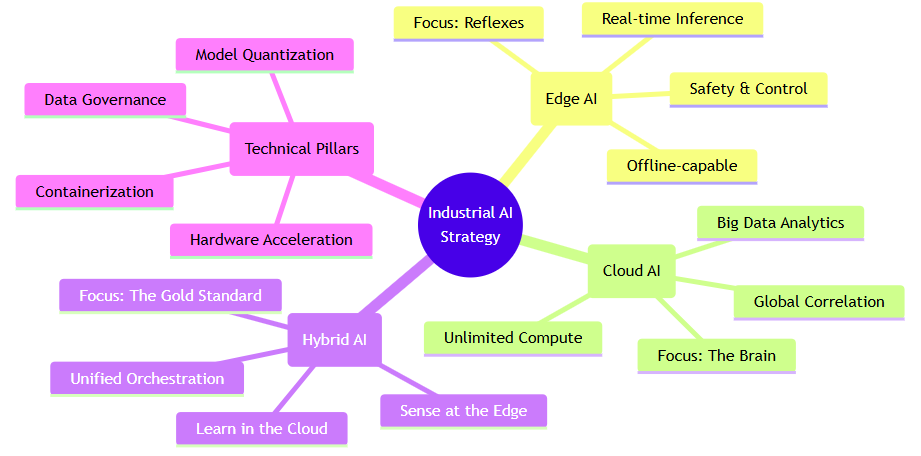
Edge vs Cloud AI Architecture Comparison


Edge AI: The "Reflexes"

The spinal cord. It reacts instantly to stimulus without waiting for the brain.

Focus: Real-time processing directly on the factory floor.

Practical Example: An automated welding arm that detects a thermal error and stops instantly—not in 2 seconds, not in 500 milliseconds—instantly—to prevent a defect.

Latency: Milliseconds.

Connectivity Required: Zero. Works offline.

Best For: Safety systems, emergency stops, real-time quality control, vibration monitoring.


Cloud AI: The "Brain"

The central intelligence that analyzes trends over years to drive long-term strategy.

Focus: Massive data storage and complex pattern recognition across global operations.

Practical Example: Analyzing sensor data from 50 global plants to determine which specific gearbox model—Batch #47C, manufactured in March 2025—needs predictive maintenance across the entire fleet.

Latency: Seconds to minutes.

Connectivity Required: Stable internet.

Best For: Fleet-wide analytics, supply chain optimization, training new models.


Hybrid AI: The Gold Standard

"Sense at the Edge. Learn in the Cloud."

Layer Function Example
Edge Immediate, safe operations Detects anomaly, stops machine in real time
Cloud Refines the "Master Model" Analyzes 10,000 anomalies across all factories
Feedback Loop Pushes updates back to Edge Every machine gets smarter over time

The Benefit: You get the speed of Edge and the intelligence of Cloud. No trade-off required.

Related Reading: Smarter Enterprise Search through Hybrid AI


Technical Deep Dive: What Your Engineers Are Talking About

For manufacturing leaders, understanding these two concepts is key to evaluating AI proposals from your technical teams.

What is Real-Time Inference?

This is the moment your AI model processes new data—like a sensor reading or a camera frame—to make a prediction.

The Edge Advantage: Inference happens on the machine in <10 milliseconds.

The Cloud Risk: Sending data to the cloud introduces network latency. At 60mph on an assembly line, 100 milliseconds = 9 feet of product moving past the sensor before you get an answer.

The Verdict: If your production line moves faster than your network, you need Edge.

What is Model Quantization?

This is the engineering magic that makes Edge AI possible.

Quantization converts complex, high-precision AI models (32-bit floating point) into a lower-precision format (8-bit integer).

What it does:

  • Compresses model size by 75%
  • Speeds up inference by 2-4x
  • Runs on a tiny industrial chip costing $15 instead of a $2,000 GPU

The Trade-off: Negligible accuracy loss (typically <1%)

The Result: A complex AI "brain" running on a thermostat-sized chip, deployed across hundreds of machines.

See how we architected these systems: Extracting Website Content for RAG and AI Pipelines


The Decision Maker's Comparison Matrix

Feature Edge AI (On-Premise) Cloud AI Hybrid (Shark AI)
Latency Instant (<10ms) Variable (50-500ms+) Best of both
Internet Required? No Yes Edge works offline
Data Privacy High (data stays on-site) Standard cloud governance Sensitive data stays local
Processing Power Limited by chip Massive scale Balanced
Best For Real-time reflexes Strategic analysis Complete nervous system
Cost Model Fixed hardware Pay-as-you-go Optimized hybrid

The Business Impact: ROI and Operational Readiness

Cost Efficiency

By filtering data at the Edge—sending only anomalies, not every sensor reading—to the Cloud, you reduce:

  • Data storage costs: 70-90% reduction
  • Data transmission costs: 80% reduction
  • Cloud compute costs: 60% reduction

Insurance for Uptime

Edge-based predictive maintenance detects failures before they happen.

The ROI: One prevented spindle seizure pays for the entire Edge deployment across your factory.

Global Scalability

Using containerization (Docker, Kubernetes), you can replicate successful AI pilots across dozens of global facilities in days, not months.


The Leadership Readiness Checklist

Before starting your next AI project, audit your environment:

Check Question Red Flag
Data Audit Do you have clean, labeled data from your PLCs?
Network Stability Is your shop floor connectivity reliable?
Latency Requirements Can you tolerate 500ms delays?
Compliance & Trust Does data need to stay on-site?

Why In-House Teams Often Get This Wrong

Many manufacturers start with Cloud-only AI because it's easier to prototype.

Then they discover:

  • The network drops during third shift
  • Latency causes quality escapes
  • Cloud bills explode when they scale
  • Their best IP is sitting on a server they don't control

The fix: Start with Edge-first architecture. Use Cloud for training and orchestration. Design for hybrid from Day 1.


The Closing Scene: Stop Choosing. Start Orchestrating.

Here's what most AI vendors won't tell you:

The Edge vs. Cloud debate is a false choice.

The winning manufacturers aren't picking one. They're building a nervous system:

  • Reflexes at the Edge for split-second safety
  • Memory in the factory for local intelligence
  • Reasoning in the Cloud for global strategy

Your factory already has this architecture. Your operators have reflexes. Your plant manager has memory. Your executive team has strategic reasoning.

Your AI should too.


Your Move

You have two choices:

Option A: Keep the debate going. Keep asking "Edge or Cloud?" Keep waiting for the perfect answer while your competitors ship.

Option B: Call us. Let us audit one production line. Let us show you what hybrid AI looks like in real time. Let us build your factory's nervous system.

Stop choosing. Start orchestrating.

Contact Shark AI Solutions for an Architectural Assessment


Also exploring predictive maintenance? See how we're Using CNC Data Richness to Predict Tomorrow's OEE.

Edge vs. Cloud AI in Manufacturing: A Strategic Architectural Guide

Author: Dr. Shiney Jeyaraj

Published: 2026-05-20

Category: Industrial AI

Reading Time: 6 min read

Tags: Edge AI, Cloud AI, Industrial AI, Manufacturing, Hybrid Architecture

Excerpt: Choosing between Edge and Cloud for manufacturing AI is a critical architectural decision. This guide outlines a hybrid framework where Edge manages real-time 'reflexes' and Cloud orchestrates strategic intelligence.

Article Content

Edge vs. Cloud AI in Manufacturing: A Strategic Architectural Guide At a Glance: The Nervous System of Smart Manufacturing The Decision: Choosing between Edge and Cloud AI is a critical architectural choice balancing latency, cost, and connectivity. The Framework: Edge handles real-time, time-sensitive "reflexes" while Cloud orchestrates long-term analytical reasoning. The Gold Standard: Hybrid AI that "Senses at the Edge and Learns in the Cloud." The Result: Production resilience, security, global scalability, and reduced unplanned downtime. The Opening Scene: The Split-Second That Costs a Million Dollars Picture this. It's 3:17 AM on a Tuesday. A CNC spindle in your flagship factory is running at 22,000 RPM. A microscopic thermal anomaly begins—0.3 degrees above baseline. Nothing dramatic. Nothing a human would notice. But in 47 seconds, that spindle will seize. The tool will shatter. Three hundred parts will go to scrap. Your 6 AM shipment window will close. Now ask yourself: Where should the intelligence that prevents this disaster live? In the Cloud, 800 miles away, waiting for a network packet? Or on the machine itself, watching every millisecond? This is the Edge vs. Cloud question. And your answer will define your factory's future. The Architecture: Your Factory as a Human Nervous System To understand where AI should live, visualize your entire manufacturing operation as the human nervous system. Edge AI: The "Reflexes" The spinal cord. It reacts instantly to stimulus without waiting for the brain. Focus: Real-time processing directly on the factory floor. Practical Example: An automated welding arm that detects a thermal error and stops instantly—not in 2 seconds, not in 500 milliseconds— instantly —to prevent a defect. Latency: Milliseconds. Connectivity Required: Zero. Works offline. Best For: Safety systems, emergency stops, real-time quality control, vibration monitoring. Cloud AI: The "Brain" The central intelligence that analyzes trends over years to drive long-term strategy. Focus: Massive data storage and complex pattern recognition across global operations. Practical Example: Analyzing sensor data from 50 global plants to determine which specific gearbox model—Batch #47C, manufactured in March 2025—needs predictive maintenance across the entire fleet. Latency: Seconds to minutes. Connectivity Required: Stable internet. Best For: Fleet-wide analytics, supply chain optimization, training new models. Hybrid AI: The Gold Standard "Sense at the Edge. Learn in the Cloud." Layer Function Example Edge Immediate, safe operations Detects anomaly, stops machine in real time Cloud Refines the "Master Model" Analyzes 10,000 anomalies across all factories Feedback Loop Pushes updates back to Edge Every machine gets smarter over time The Benefit: You get the speed of Edge and the intelligence of Cloud. No trade-off required. Related Reading: Smarter Enterprise Search through Hybrid AI Technical Deep Dive: What Your Engineers Are Talking About For manufacturing leaders, understanding these two concepts is key to evaluating AI proposals from your technical teams. What is Real-Time Inference? This is the moment your AI model processes new data—like a sensor reading or a camera frame—to make a prediction. The Edge Advantage: Inference happens on the machine in &#x3C;10 milliseconds. The Cloud Risk: Sending data to the cloud introduces network latency. At 60mph on an assembly line, 100 milliseconds = 9 feet of product moving past the sensor before you get an answer. The Verdict: If your production line moves faster than your network, you need Edge. What is Model Quantization? This is the engineering magic that makes Edge AI possible. Quantization converts complex, high-precision AI models (32-bit floating point) into a lower-precision format (8-bit integer). What it does: Compresses model size by 75% Speeds up inference by 2-4x Runs on a tiny industrial chip costing $15 instead of a $2,000 GPU The Trade-off: Negligible accuracy loss (typically &#x3C;1%) The Result: A complex AI "brain" running on a thermostat-sized chip, deployed across hundreds of machines. See how we architected these systems: Extracting Website Content for RAG and AI Pipelines The Decision Maker's Comparison Matrix Feature Edge AI (On-Premise) Cloud AI Hybrid (Shark AI) Latency Instant (&#x3C;10ms) Variable (50-500ms+) Best of both Internet Required? No Yes Edge works offline Data Privacy High (data stays on-site) Standard cloud governance Sensitive data stays local Processing Power Limited by chip Massive scale Balanced Best For Real-time reflexes Strategic analysis Complete nervous system Cost Model Fixed hardware Pay-as-you-go Optimized hybrid The Business Impact: ROI and Operational Readiness Cost Efficiency By filtering data at the Edge—sending only anomalies, not every sensor reading—to the Cloud, you reduce: Data storage costs: 70-90% reduction Data transmission costs: 80% reduction Cloud compute costs: 60% reduction Insurance for Uptime Edge-based predictive maintenance detects failures before they happen. The ROI: One prevented spindle seizure pays for the entire Edge deployment across your factory. Global Scalability Using containerization (Docker, Kubernetes), you can replicate successful AI pilots across dozens of global facilities in days, not months. The Leadership Readiness Checklist Before starting your next AI project, audit your environment: Check Question Red Flag ☐ Data Audit Do you have clean, labeled data from your PLCs? ☐ Network Stability Is your shop floor connectivity reliable? ☐ Latency Requirements Can you tolerate 500ms delays? ☐ Compliance &#x26; Trust Does data need to stay on-site? Why In-House Teams Often Get This Wrong Many manufacturers start with Cloud-only AI because it's easier to prototype. Then they discover: The network drops during third shift Latency causes quality escapes Cloud bills explode when they scale Their best IP is sitting on a server they don't control The fix: Start with Edge-first architecture. Use Cloud for training and orchestration. Design for hybrid from Day 1. The Closing Scene: Stop Choosing. Start Orchestrating. Here's what most AI vendors won't tell you: The Edge vs. Cloud debate is a false choice. The winning manufacturers aren't picking one. They're building a nervous system : Reflexes at the Edge for split-second safety Memory in the factory for local intelligence Reasoning in the Cloud for global strategy Your factory already has this architecture. Your operators have reflexes. Your plant manager has memory. Your executive team has strategic reasoning. Your AI should too. Your Move You have two choices: Option A: Keep the debate going. Keep asking "Edge or Cloud?" Keep waiting for the perfect answer while your competitors ship. Option B: Call us. Let us audit one production line. Let us show you what hybrid AI looks like in real time. Let us build your factory's nervous system. Stop choosing. Start orchestrating. Contact Shark AI Solutions for an Architectural Assessment Also exploring predictive maintenance? See how we're Using CNC Data Richness to Predict Tomorrow's OEE .