Looking back at 2025, one insight shaped everything we built at Shark AI:
Talking to AI is easy. Getting it to actually do the work is hard.
While much of the industry focused on making chatbots sound smarter, we focused on something far more valuable — turning AI from a conversational layer into a system that executes real business tasks.
That shift led us to one defining concept: Agentic Workflows.
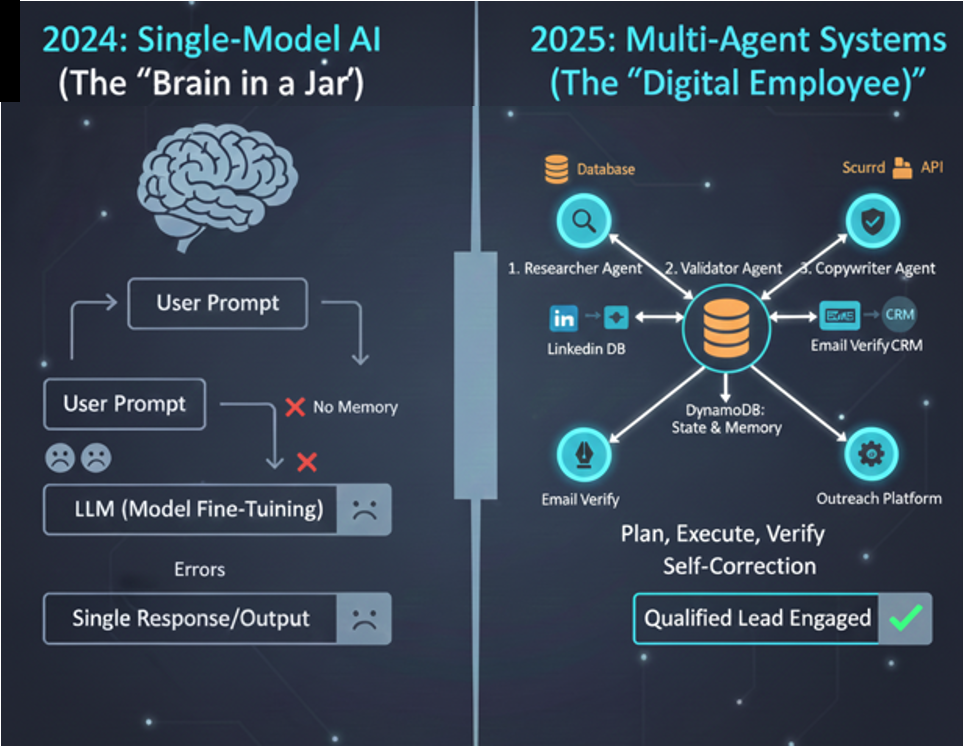
1. From Conversation to Execution
In 2024, AI behaved like a capable advisor. It could answer questions, suggest ideas, and draft content — but execution still depended on humans.
In 2025, that changed.
By adopting agentic architectures, we moved beyond prompt–response loops into autonomous reasoning systems. Using frameworks like LangGraph and CrewAI, we designed workflows where AI agents could:
- Plan tasks autonomously
- Execute multi-step actions
- Detect failures or missing information
- Retry, adapt, and complete objectives without human intervention
Instead of stopping at "here's what you should do," these systems actually do it.
This transition—from reactive chatbots to deterministic, goal-driven agents—is what allowed AI to move from experimentation into production.
2. The Engine Behind the Intelligence: Full-Stack Agent Architecture
An agent is only as powerful as the system around it. At Shark AI, we treat agents not as scripts, but as components inside a production-grade software stack.
The Brain: Orchestration & Execution
We run agent logic through FastAPI-based orchestration layers, enabling long-running, asynchronous workflows that don't break under real-world conditions.
Persistent State: No More Amnesia
We implement robust state management so workflows can pause, resume, or recover seamlessly. Network failures or partial executions no longer reset progress.
The Interface: Full Visibility & Control
We build React-based dashboards that act as a cockpit for digital employees. Teams can see what agents are researching, validating, or generating—bringing transparency and trust into AI-driven operations.
This philosophy aligns closely with our work on hybrid enterprise search, where structured data, unstructured content, and AI reasoning converge into a single decision layer.
Read more: https://www.sharkaisolutions.com/blog/smarter_enterprise_search_hybrid_ai/
3. Use Case: From Manual Lead Research to Autonomous Sales Execution
A practical example of this architecture in action is our Autonomous Sales Engine.
Traditionally, sales teams spend hours manually researching prospects, validating data, and crafting outreach—work that is repetitive, slow, and difficult to scale.
With an agentic system, this entire workflow becomes autonomous:
-
Research Agent
Collects firmographic data, intent signals, and online activity across multiple sources. -
Validation Agent
Cross-checks findings against internal databases to eliminate noise and ensure accuracy. -
Copywriting Agent
Generates highly contextual, intent-aware outreach based on real buyer signals. -
Manager Agent
Oversees execution, validates outputs, and triggers downstream actions through secure APIs.
What once took hours of manual effort now runs continuously in the background—producing qualified, context-rich outreach at scale.
This same agent-based approach also powers our work in eliminating manual review bottlenecks, as explored in our article on moving beyond manual review with agentic AI:
https://www.sharkaisolutions.com/blog/beyond-manual-review-agentic-ai/
4. Reliability, Security, and the MCP Advantage
To operate at enterprise scale, autonomy must be paired with control.
- Stateful Scalability: Thousands of concurrent workflows can run without losing context.
- Secure Data Boundaries: Using the Model Context Protocol (MCP), agents interact with internal systems through controlled interfaces—ensuring sensitive data never leaves trusted environments.
This architecture enables AI systems that are not only powerful, but safe and governable.
5. Why Results Matter More Than Benchmarks
Benchmarks measure intelligence. Businesses care about outcomes.
Agentic workflows don't just improve writing speed or response quality—they eliminate operational bottlenecks and replace manual effort with reliable automation.
At Shark AI, we've moved beyond building "smart tools."
We build Digital Employees—systems designed to think, act, and deliver results continuously.
Ready to Build Your Own Digital Workforce?
If you're exploring how AI can move from experimentation to real operational impact, we'd love to help.