AI Strategy

Future-Proof AI Systems: Scaling Enterprises Without Vendor Lock-In

The bigger challenge is future-proofing: designing AI systems that adapt to new technologies, avoid costly vendor lock-in, and meet evolving compliance standards. Without this foresight, enterprises risk building brittle systems that limit growth, compromise privacy, and inflate costs over time.

By SharkAI Team10 min read
Future-Proof AIVendor Lock-InEnterprise ArchitectureMCPComplianceAI Strategy

Future-Proof AI Systems: Scaling Enterprises Without Vendor Lock-In

In our earlier post, Build vs. Buy AI: Choosing Between Custom AI Solutions and Off-the-Shelf Tools for Enterprises, we explored the trade-offs between in-house custom AI and vendor-provided tools. But making that choice is just the start.

The bigger challenge is future-proofing: designing AI systems that adapt to new technologies, avoid costly vendor lock-in, and meet evolving compliance standards. Without this foresight, enterprises risk building brittle systems that limit growth, compromise privacy, and inflate costs over time.

Why Vendor Lock-In Is a Risk Enterprises Can’t Ignore

Vendor lock-in happens when your organization becomes dependent on one provider’s tools or APIs. While it may seem convenient at first, the long-term risks include:

  • Escalating Costs – Vendors can raise usage or licensing fees once switching becomes too difficult.
  • Limited Flexibility – Feature changes or product shutdowns ripple through your workflows.
  • Compliance Gaps – Vendors may not adapt fast enough to regional data or regulatory requirements.
  • Innovation Bottlenecks – You lose the ability to integrate new models or services as they emerge.

Enterprises that treat AI as a core strategic capability—not just another IT service—must address lock-in early.

Vendor Lock-In and the Black-Box Problem

Lock-in often combines with another challenge: black-box AI. Proprietary systems may deliver outputs, but offer little insight into how those outputs are generated.

  • Opaque Models: Training data, biases, and decision logic are hidden.
  • Compliance Risks: Laws like GDPR, HIPAA, and the AI Act require explainability—something black-box AI can’t always deliver.
  • Migration Barriers: Without transparency, rebuilding or replicating models elsewhere becomes prohibitively complex.

Together, vendor lock-in + black-box AI (as explored in Turning AI from a Black Box into a Transparent System: How Evals and Google's Stax Build Trustworthy Copilots) form a risk multiplier—limiting agility, raising compliance concerns, and reducing control over enterprise strategy.

The solution is a modular architecture with swappable AI services and interoperability protocols like MCP (Model Context Protocol). Read our article [Part 2: How to Integrate LangGraph with an MCP RAG Server for Smarter AI Agents?] : https://www.sharkaisolutions.com/blog/medium_post2. These enable enterprises to integrate AI securely while retaining oversight and flexibility.

The Principles of Future-Proof AI

Future-proofing doesn’t mean predicting the next big model—it means designing AI that can adapt. The guiding principles are:

  1. Modularity – Break solutions into components (chat, search, analytics) that evolve independently.

  2. Configuration over Code – Minimize hard-coding for easier updates.

  3. Standard Interfaces – Use open APIs for vendor swaps.

  4. Data Ownership – Keep data in your own enterprise lake or warehouse.

  5. Governance by Design – Embed compliance, observability, and security from day one.

What Future-Proof Architecture Looks Like
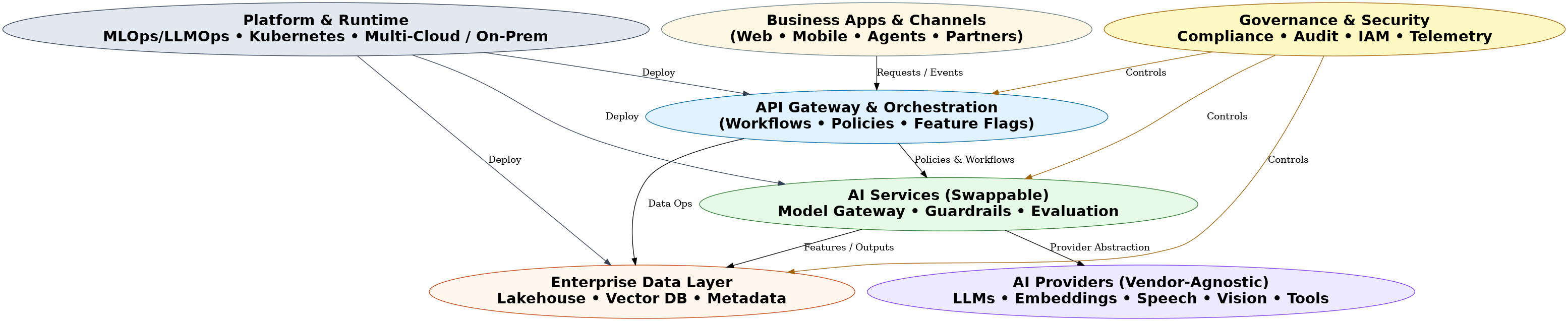
Future-Proof AI Architecture Diagram

A future-proof AI stack is built in layers, each playing a unique role:

Business Apps & Channels

Where AI meets customers and employees: websites, mobile apps, partner integrations, CRM dashboards.
Impact: Seamless integration here drives adoption and ROI.

API Gateway & Orchestration

The traffic controller of your stack: authenticating requests, enforcing policies, coordinating workflows.
Impact: Prevents fragile, ad hoc integrations that can’t scale.

AI Services (Swappable)

The “control room” of enterprise AI: model gateways, prompt services, guardrails, evaluation systems—plus MCP, which connects external APIs and enterprise systems in a structured, portable way.
Impact: Lets you switch providers, add new models, and enforce compliance consistently.

AI Providers (Vendor-Agnostic)

Engines like GPT-4, Claude, open-source LLMs, embeddings, speech/vision tools, and plugins.
Impact: Vendor-agnosticism ensures agility and resilience against market shifts.

Enterprise Data Layer

Your backbone: data lakehouse, feature store, vector DB, metadata tracking.
Impact: Keeping ownership here means portability, compliance, and long-term scalability.

Governance & Security

Auditability, IAM, data masking, telemetry, and regulatory compliance (GDPR, HIPAA, AI Act).
Impact: Transforms compliance from an overhead cost into a competitive advantage.

Platform & Runtime

Deployment pipelines, CI/CD, Kubernetes, multi-cloud or hybrid environments.
Impact: Ensures AI runs where business needs dictate, not where vendors constrain you.

Real-World Enterprise Scenario

A global retailer adopted a SaaS chatbot vendor to serve two countries. But expansion exposed weaknesses:

  • Multilingual support was inadequate.
  • New data residency laws conflicted with the vendor’s hosting.
  • Annual licensing costs doubled as usage scaled.

By transitioning to a vendor-agnostic, MCP-enabled architecture, the retailer regained control:

  • A model gateway routed to multiple AI providers.
  • An enterprise-owned vector DB handled retrieval securely.
  • Compliance guardrails ensured regulatory adherence.

Within a year, support costs dropped 30%, compliance risks were eliminated, and the company gained the flexibility to adopt new LLMs as they matured.

Balancing Cost and Control

Enterprises often ask: “Isn’t it cheaper to stick with one vendor?”

  • Short-term: Vendor tools may provide quick wins at low upfront cost.
  • Long-term: Modular, interoperable systems reduce migration pain, keep compliance manageable, and prove more cost-efficient over 2–3 years.

True ROI comes not from speed alone but from sustainable ownership and adaptability.

Governance and Compliance as Strategy

Strong governance isn’t just about avoiding fines—it’s a strategic enabler. Enterprises that embed privacy-by-design, compliance telemetry, and explainability into their stack gain both resilience and trust.

This aligns with the fact that compliance and adaptability aren’t optional, they’re differentiators.

Executive Takeaways

For decision-makers evaluating AI roadmaps, here’s what matters most:

  • Avoid vendor lock-in. Don’t let convenience today become constraint tomorrow.
  • Reject black-box dependencies. Maintain transparency, explainability, and compliance readiness.
  • Prioritize modularity. Build flexible, config-driven architectures.
  • Own your data. Control your enterprise’s most strategic asset.
  • Adopt MCP strategically. Enable interoperability, portability, and sustainable AI adoption across systems.
  • See governance as strategy. Compliance and security unlock—not hinder—scalability.

At SharkAI Solutions, we help enterprises build AI systems that are scalable, privacy-first, and vendor-agnostic. Read more How SharkAI Solutions Helps Businesses Unlock the True Potential of AI

Contact SharkAI Solutions to start your enterprise AI journey today.

Future-Proof AI Systems: Scaling Enterprises Without Vendor Lock-In

Author: SharkAI Team

Published: 2025-09-22

Category: AI Strategy

Reading Time: 10 min read

Tags: Future-Proof AI, Vendor Lock-In, Enterprise Architecture, MCP, Compliance, AI Strategy

Excerpt: The bigger challenge is future-proofing: designing AI systems that adapt to new technologies, avoid costly vendor lock-in, and meet evolving compliance standards. Without this foresight, enterprises risk building brittle systems that limit growth, compromise privacy, and inflate costs over time.

Article Content

Future-Proof AI Systems: Scaling Enterprises Without Vendor Lock-In In our earlier post, Build vs. Buy AI: Choosing Between Custom AI Solutions and Off-the-Shelf Tools for Enterprises , we explored the trade-offs between in-house custom AI and vendor-provided tools. But making that choice is just the start. The bigger challenge is future-proofing : designing AI systems that adapt to new technologies, avoid costly vendor lock-in, and meet evolving compliance standards. Without this foresight, enterprises risk building brittle systems that limit growth, compromise privacy, and inflate costs over time. Why Vendor Lock-In Is a Risk Enterprises Can’t Ignore Vendor lock-in happens when your organization becomes dependent on one provider’s tools or APIs. While it may seem convenient at first, the long-term risks include: Escalating Costs – Vendors can raise usage or licensing fees once switching becomes too difficult. Limited Flexibility – Feature changes or product shutdowns ripple through your workflows. Compliance Gaps – Vendors may not adapt fast enough to regional data or regulatory requirements. Innovation Bottlenecks – You lose the ability to integrate new models or services as they emerge. Enterprises that treat AI as a core strategic capability—not just another IT service—must address lock-in early. Vendor Lock-In and the Black-Box Problem Lock-in often combines with another challenge: black-box AI . Proprietary systems may deliver outputs, but offer little insight into how those outputs are generated. Opaque Models: Training data, biases, and decision logic are hidden. Compliance Risks: Laws like GDPR, HIPAA, and the AI Act require explainability—something black-box AI can’t always deliver. Migration Barriers: Without transparency, rebuilding or replicating models elsewhere becomes prohibitively complex. Together, vendor lock-in + black-box AI (as explored in Turning AI from a Black Box into a Transparent System: How Evals and Google's Stax Build Trustworthy Copilots ) form a risk multiplier—limiting agility, raising compliance concerns, and reducing control over enterprise strategy. The solution is a modular architecture with swappable AI services and interoperability protocols like MCP (Model Context Protocol) . Read our article [Part 2: How to Integrate LangGraph with an MCP RAG Server for Smarter AI Agents?] : https://www.sharkaisolutions.com/blog/medium_post2 . These enable enterprises to integrate AI securely while retaining oversight and flexibility. The Principles of Future-Proof AI Future-proofing doesn’t mean predicting the next big model—it means designing AI that can adapt. The guiding principles are: Modularity – Break solutions into components (chat, search, analytics) that evolve independently. Configuration over Code – Minimize hard-coding for easier updates. Standard Interfaces – Use open APIs for vendor swaps. Data Ownership – Keep data in your own enterprise lake or warehouse. Governance by Design – Embed compliance, observability, and security from day one. What Future-Proof Architecture Looks Like A future-proof AI stack is built in layers , each playing a unique role: Business Apps & Channels Where AI meets customers and employees: websites, mobile apps, partner integrations, CRM dashboards. Impact: Seamless integration here drives adoption and ROI. API Gateway & Orchestration The traffic controller of your stack: authenticating requests, enforcing policies, coordinating workflows. Impact: Prevents fragile, ad hoc integrations that can’t scale. AI Services (Swappable) The “control room” of enterprise AI: model gateways, prompt services, guardrails, evaluation systems—plus MCP , which connects external APIs and enterprise systems in a structured, portable way. Impact: Lets you switch providers, add new models, and enforce compliance consistently. AI Providers (Vendor-Agnostic) Engines like GPT-4, Claude, open-source LLMs, embeddings, speech/vision tools, and plugins. Impact: Vendor-agnosticism ensures agility and resilience against market shifts. Enterprise Data Layer Your backbone: data lakehouse, feature store, vector DB, metadata tracking. Impact: Keeping ownership here means portability, compliance, and long-term scalability. Governance & Security Auditability, IAM, data masking, telemetry, and regulatory compliance (GDPR, HIPAA, AI Act). Impact: Transforms compliance from an overhead cost into a competitive advantage. Platform & Runtime Deployment pipelines, CI/CD, Kubernetes, multi-cloud or hybrid environments. Impact: Ensures AI runs where business needs dictate, not where vendors constrain you. Real-World Enterprise Scenario A global retailer adopted a SaaS chatbot vendor to serve two countries. But expansion exposed weaknesses: Multilingual support was inadequate. New data residency laws conflicted with the vendor’s hosting. Annual licensing costs doubled as usage scaled. By transitioning to a vendor-agnostic, MCP-enabled architecture , the retailer regained control: A model gateway routed to multiple AI providers. An enterprise-owned vector DB handled retrieval securely. Compliance guardrails ensured regulatory adherence. Within a year, support costs dropped 30%, compliance risks were eliminated, and the company gained the flexibility to adopt new LLMs as they matured. Balancing Cost and Control Enterprises often ask: “Isn’t it cheaper to stick with one vendor?” Short-term: Vendor tools may provide quick wins at low upfront cost. Long-term: Modular, interoperable systems reduce migration pain, keep compliance manageable, and prove more cost-efficient over 2–3 years. True ROI comes not from speed alone but from sustainable ownership and adaptability. Governance and Compliance as Strategy Strong governance isn’t just about avoiding fines—it’s a strategic enabler. Enterprises that embed privacy-by-design, compliance telemetry, and explainability into their stack gain both resilience and trust. This aligns with the fact that compliance and adaptability aren’t optional, they’re differentiators. Executive Takeaways For decision-makers evaluating AI roadmaps, here’s what matters most: Avoid vendor lock-in. Don’t let convenience today become constraint tomorrow. Reject black-box dependencies. Maintain transparency, explainability, and compliance readiness. Prioritize modularity. Build flexible, config-driven architectures. Own your data. Control your enterprise’s most strategic asset. Adopt MCP strategically. Enable interoperability, portability, and sustainable AI adoption across systems. See governance as strategy. Compliance and security unlock—not hinder—scalability. At SharkAI Solutions , we help enterprises build AI systems that are scalable, privacy-first, and vendor-agnostic . Read more How SharkAI Solutions Helps Businesses Unlock the True Potential of AI Contact SharkAI Solutions to start your enterprise AI journey today.