Does Your Factory Actually Need a Small Language Model (SLM)?
Why the smartest AI for your shop floor is often the smallest — and how to tell if it's the right fit for your plant.
Key Takeaways (At a Glance)
- A small language model (SLM) is a compact AI that runs on ordinary on-site hardware — often a single computer — without the internet or an expensive data-center GPU.
- For focused, repetitive factory language tasks, an SLM can deliver most of the quality of a giant model at a fraction of the cost, with faster answers and your data never leaving the building.
- SLMs are not a replacement for large models. The right question isn't "small or large?" — it's "which task belongs to which size?"
- The best setups are usually hybrid: a small model handles the routine 90–95% on the floor, and a large cloud model handles the rare, complex 5%.
- You likely need an SLM if you have repetitive language tasks, sensitive data, shaky connectivity, or high query volume. You probably don't if your needs are open-ended, low-volume, and reasoning-heavy.
The 2 a.m. Question
It's 2 a.m. A maintenance technician is standing in front of a stalled packaging line with a fault code on the screen and a 400-page manual in a binder that hasn't been opened since installation. The one engineer who truly understands this machine is asleep, three time zones away.
What the technician needs isn't a genius. It's a fast, reliable answer to one narrow question: "Fault E-217 on this exact line — what do I check first?"
That's a language task. It needs AI that can read your manuals and talk back in plain words. But here's the part most vendors won't tell you: it does not need the largest, most expensive AI brain on the market. It needs the right-sized one — small enough to live on the factory floor, smart enough to know your factory cold.
That right-sized brain has a name: a small language model.
What Is a Small Language Model (SLM)?
A small language model (SLM) is a compact AI model — typically between 1 and 9 billion "parameters" (think of parameters as the model's brain cells) — that is small enough to run on everyday hardware you already own. Many SLMs run comfortably on a computer with 8 GB of memory, the kind of spec found in a decent laptop. No internet connection required, no rented cloud supercomputer.
By contrast, the large language models (LLMs) behind familiar chatbots can have hundreds of billions of parameters. They are brilliant generalists, but they're expensive to run, live in someone else's cloud, and need a constant internet connection.
A useful analogy: a large model is a world-class consultant who knows a little about everything and charges by the minute. A small model is a specialist you've trained on your equipment, your procedures, and your products — and who works the night shift for free, on a machine bolted to your wall.
In 2026, that specialist has become genuinely capable. Independent comparisons suggest a well-chosen, fine-tuned SLM can reach roughly 80–90% of a frontier model's quality on focused, well-defined tasks — which is more than enough for most of what a factory actually asks an AI to do.
What Can an SLM Do on a Factory Floor?
SLMs handle language — reading, summarizing, classifying, answering, and translating text. On a shop floor, that covers a surprising amount of daily work:
- Instant manual and SOP answers. An operator asks a plain question and gets the exact procedure pulled from your maintenance manuals — no binder, no waiting.
- Shift handover summaries. Turn messy end-of-shift notes into a clean, consistent summary the next crew can actually use.
- Fault-code and work-order triage. Read an incoming issue, classify it, and route it to the right team automatically.
- Quality and compliance reports. Draft first-pass inspection or compliance write-ups from raw notes, ready for a human to approve.
- Multilingual instructions. Translate work instructions on the fly for a diverse workforce — a real advantage on Indian shop floors, where models like Google's Gemma 3 support Hindi, Tamil, Telugu, and dozens more languages at production quality.
Notice what these have in common: they're narrow, repetitive, and built on your own documents. That's exactly the sweet spot where small beats large.
Why Factories Are Choosing Small: Four Real Advantages
1. Your data never leaves the building
An SLM runs on-premises, so sensitive information — proprietary processes, designs, defect data, supplier terms — stays inside your four walls. For manufacturers worried about protecting intellectual property or meeting data-residency rules, this is often the single biggest reason to go small.
2. It works when the internet doesn't
Shop-floor connectivity is rarely flawless, and the network always seems to drop during third shift. Because an SLM runs locally, it keeps answering even when the connection is down. (This is the same "sense and act at the edge" principle we covered in our Edge vs. Cloud AI guide.)
3. It's fast
A local model answers in a fraction of a second because it isn't sending your question 800 miles to a data center and waiting for the reply. On a busy line, that responsiveness matters.
4. It's dramatically cheaper at scale
Large cloud models charge per query, and those bills balloon as usage grows. A small model you run yourself has a largely fixed cost. When you're handling thousands of queries a day across multiple plants, the savings compound fast — by some 2026 estimates, smart "small-first" routing cuts running costs by an order of magnitude or more.
When You Still Want the Big Model
Going small is not always the answer, and pretending otherwise would set you up to fail. Reach for a large model when the task is:
- Open-ended or reasoning-heavy — strategic analysis, complex troubleshooting across many unknowns, or anything that benefits from broad world knowledge.
- Low-volume and high-variety — if you only run a task occasionally and it's different every time, the cost savings of a small model never add up, and the large model's flexibility wins.
- Beyond your in-house data — questions that require knowledge your own documents don't contain.
The honest rule of thumb: small models excel at depth in a narrow lane; large models excel at breadth across many lanes.
The Best of Both: The Hybrid Approach
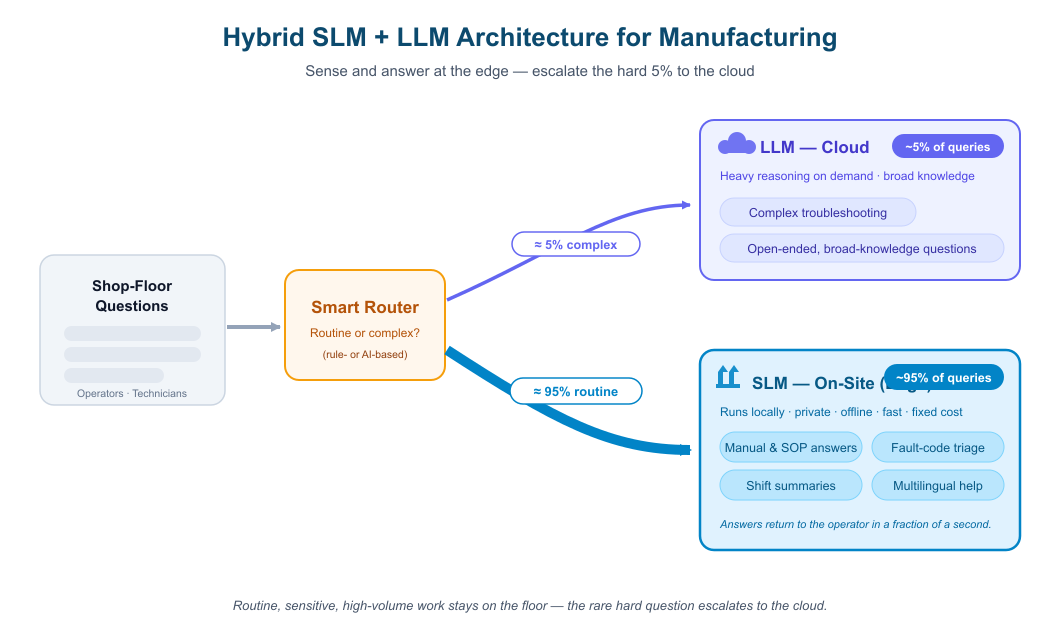
In practice, the smartest factories don't choose one or the other. They route the work:
The small on-site model handles the routine 90–95% of questions instantly and privately. The rare, genuinely complex 5% gets passed up to a large cloud model for heavier reasoning.
This mirrors the "sense at the edge, learn in the cloud" pattern that works so well for industrial AI: keep the fast, common, sensitive work local, and reserve the expensive heavyweight for when it's truly needed. You get the speed, privacy, and cost of small — with the depth of large available on demand.
A Quick Tour of Today's Small Language Models
You don't need to memorize these, but it helps to know the landscape is real and mature. A few of the most widely used SLMs in 2026:
| Model | Maker | Known for |
|---|---|---|
| Phi-4 / Phi-4-mini | Microsoft | Strong reasoning and structured data extraction; runs on a machine with ~8 GB of memory |
| Gemma 3 | Multilingual (140+ languages) and able to "read" images — useful for pairing with defect detection | |
| Llama 3.2 / 3.3 | Meta | The most widely supported option, with the largest ecosystem of tools and tutorials |
| Mistral Small 3 | Mistral AI | Fast and especially friendly to fine-tuning on your own data |
| Qwen 3 | Alibaba | Strong multilingual performance at a very small size |
The takeaway isn't "pick this one." It's that capable, open, on-premise options now exist for nearly every factory scenario — and the right choice depends on your specific task, your data, and your hardware. (Choosing among them is a close cousin of the build-and-customize decisions we explored in The Fine-Tuning Fallacy and Open Source AI vs. Third-Party AI.)
SLM vs. LLM: Which Does Your Factory Need?
| Consideration | Lean toward an SLM | Lean toward an LLM (cloud) |
|---|---|---|
| Task type | Narrow, repetitive, well-defined | Open-ended, varied, reasoning-heavy |
| Data sensitivity | Must stay on-site | Standard cloud governance is acceptable |
| Connectivity | Unreliable or air-gapped | Stable, always-on internet |
| Query volume | High and constant | Low or occasional |
| Cost model | Predictable, fixed | Pay-per-use is fine |
| Best fit | Manual Q&A, triage, summaries, translation | Strategy, complex analysis, one-off research |
If most of your row checks land in the left column, an SLM — or a hybrid built around one — is very likely the right-sized choice.
Is Your Factory Ready for an SLM? A 4-Point Checklist
Before you invest, audit your environment honestly:
| Check | Question | Action |
|---|---|---|
| ☐ | Do you have a narrow, repetitive language task worth automating? | If everything is one-off and unpredictable, hold off. |
| ☐ | Do you have your own documents to teach it? | Manuals, SOPs, maintenance logs, past work orders — the model is only as good as the knowledge you give it. |
| ☐ | Do you have somewhere to run it? | A modest on-site server or even a capable workstation is often enough. |
| ☐ | Is there a privacy, connectivity, or cost reason to keep AI local? | If yes, that's your strongest signal to go small. |
Frequently Asked Questions
What is a small language model in simple terms?
It's a compact AI that understands and generates text, small enough to run on a normal computer at your site without the internet or a costly cloud GPU. It trades broad, do-anything range for speed, privacy, and low cost on focused tasks.
How is an SLM different from a large language model (LLM)?
Size and where it runs. LLMs have hundreds of billions of parameters and run in the cloud; SLMs have a few billion and run locally. LLMs are better generalists; SLMs are better, cheaper specialists for narrow jobs.
Can a small language model run without internet?
Yes. Because it runs on your own hardware, an SLM keeps working during network outages — a key reason factories with unreliable shop-floor connectivity choose them.
Is an SLM cheaper than using a cloud AI service?
For high, steady query volumes, usually yes. Cloud models charge per query, while a locally run small model has a largely fixed cost, so savings grow as usage scales.
Will a small model be accurate enough for my factory?
For well-defined tasks built on your own documents, modern SLMs are typically accurate enough — especially when fine-tuned on your data. For open-ended reasoning, a larger model or a hybrid setup is safer.
Do I have to choose between small and large models?
No. Most successful deployments are hybrid: a small model handles the common, sensitive, high-volume work locally, and a large cloud model is called in only for rare, complex questions.
The Bottom Line
The industry reflex is to assume that better AI means bigger AI. On the factory floor, that reflex is often wrong. The model that knows your machines, your manuals, and your procedures — running fast, private, and offline right where the work happens — beats a distant genius that needs the internet to think.
You don't hire a Nobel laureate to read a gauge. The smartest move is to match the size of the brain to the size of the job.
So before you commit to an expensive, cloud-only AI strategy, it's worth asking the simpler question: does your factory actually need a small language model? For more plants than most leaders realize, the answer is yes.
Right-size your AI before you over-buy
At Shark AI Solutions, we help manufacturers match the right model to the right task — small, large, or hybrid — so you get the accuracy you need without paying for compute you don't. Let us assess one workflow on your floor and show you what right-sized AI looks like in practice.
Talk to Shark AI Solutions about an AI Assessment →
Related reading: Edge vs. Cloud AI in Manufacturing · The Fine-Tuning Fallacy · Open Source AI vs. Third-Party AI