AI Strategy

Smarter Enterprise Search with Hybrid AI

Leverage the power of Hybrid AI to create smarter, more accurate enterprise search solutions that deliver relevant results and unlock valuable insights from your data.

By SharkAI Team10 min read
Enterprise SearchHybrid AIRAGAI Strategy

Smarter Enterprise Search with Hybrid AI: How RAG, Graphs, and LLMs Unlock Hidden Knowledge

The Problem: Enterprise Search is Broken

In today’s enterprises, valuable knowledge is scattered across silos—PDFs, ERPs, CRMs, compliance documents, and SharePoint drives. Employees waste hours digging through repositories, only to find keyword-based search results that fail to capture context or intent.

A salesperson looking for “updated compliance certificates for German suppliers” might get hundreds of results but no direct answer. This inefficiency results in wasted time, higher costs, and lost opportunities.


The Need for Smarter Enterprise Search

Traditional enterprise search returns documents. What businesses really need are answers.

Large Language Models (LLMs) have shown promise in conversational search, but LLM-only solutions come with risks:

  • Hallucinations — confidently giving wrong answers.
  • Compliance Gaps — inability to enforce rules like GDPR or HIPAA.
  • Black-box Reasoning — lack of transparency and auditability.

This is why enterprises need Hybrid AI architectures that combine multiple approaches for accuracy, compliance, and scalability.

(This is also where broader AI strategy decisions come into play—see Build vs. Buy AI: Choosing Between Custom and Off-the-Shelf Solutions for how enterprises can evaluate different AI paths.)


Benefits of Hybrid AI Search

A Hybrid AI approach blends Retrieval-Augmented Generation (RAG), Knowledge Graphs, and LLMs. The result is smarter enterprise search that transforms data into reliable insights.

  • Accuracy & Context → RAG ensures answers are grounded in enterprise data.
  • Compliance & Trust → Graphs enforce business rules and hierarchies, preventing hallucinations.
  • Scalability → Works across geographies, departments, and languages.
  • Personalization → Tailors answers to user roles (legal, sales, engineering).
  • Cost Efficiency → Reduces dependency on expensive LLM fine-tuning.

(For more on scaling AI with compliance in mind, see LLMOps: The Backbone of Enterprise-Ready AI.)


The Design of Hybrid AI Architecture (with Real Enterprise Use Case)

A smarter enterprise search system is best understood as a layered architecture—each part playing a specific role in transforming raw data into compliant, actionable insights. At SharkAI Solutions, we implemented this design for a global manufacturing client struggling with fragmented supplier, product, and compliance data.
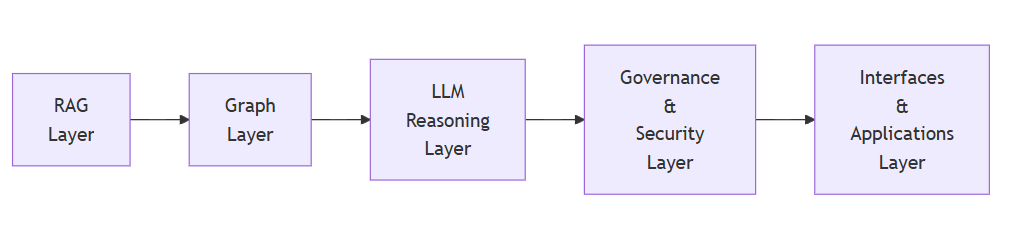
Design of Hybrid AI Architecture

1. RAG Layer (Retrieval-Augmented Generation)

  • What it does: Retrieves the most relevant information from documents, ERP systems, and compliance reports.
  • Why it matters: Grounds answers in real, up-to-date enterprise data.
  • Example: Engineers no longer had to manually search hundreds of supplier PDFs. The system instantly surfaced the latest certificate for Supplier A in Germany.

2. Graph Layer (Knowledge Graphs & Context Mapping)

  • What it does: Models relationships between suppliers, products, certifications, and regions.
  • Why it matters: Adds context and explainability to every result.
  • Example: The system could directly answer “Which suppliers in Europe are certified to provide Component X?” by tracing relationships across data.

3. LLM Reasoning Layer

  • What it does: Converts retrieved snippets and graph relationships into clear, human-readable answers.
  • Why it matters: Makes AI insights accessible to non-technical teams.
  • Example: Instead of showing five documents, it answered: “Supplier A provides Component X in Germany, certified until June 2024.”

4. Governance & Security Layer

  • What it does: Provides auditability, role-based access, and compliance enforcement.
  • Why it matters: Enterprises can trust AI outputs in regulated industries.
  • Example: Only compliance officers could view supplier certification logs, ensuring data remained secure.

5. Interfaces & Applications Layer

  • What it does: Makes insights available via portals, chatbots, and APIs.
  • Why it matters: Maximizes business impact when employees and customers can access insights across channels.
  • Example: Sales reps accessed supplier data via a mobile chatbot, engineers via a portal, all powered by the same architecture.

Business Impact for Our Manufacturing Client

Implementing this Hybrid AI architecture with RAG, Graphs, and LLMs delivered measurable results:

  • 80% faster supplier compliance checks (hours reduced to minutes).
  • Improved sales agility, with instant supplier answers during client calls.
  • Reduced downtime, as engineers could quickly identify certified replacement parts.
  • Regulatory confidence, with secure, audit-ready governance.

This case echoes a wider trend: many enterprises have data, but lack systems that turn it into value. (We explored this challenge in Unlocking Data Insights with AI: Why Indian Industries Must Act Now).


Why Enterprises Should Act Now

Enterprise data volumes are exploding. Without smarter AI-driven search, knowledge remains trapped in silos. Competitors investing early in Hybrid AI are seeing advantages in:

  • Productivity gains.
  • Faster decision-making.
  • Stronger compliance assurance.

Hybrid AI is not just about solving search—it’s about creating a future-proof AI foundation. (For a deeper dive into how future-proof architectures are designed, see Future-Proof AI Systems.)


Partner with SharkAI Solutions

At SharkAI Solutions, we specialize in designing Hybrid AI architectures for enterprises. From POCs to full-scale rollouts, we bring together RAG, Graphs, and LLMs with governance and compliance at the core.

(To know how SharkAI Solutions can solve your business problem, read How SharkAI Solutions Helps Businesses Unlock the True Potential of AI, where making AI truly useful requires bridging data silos.)

Smarter Enterprise Search with Hybrid AI

Author: SharkAI Team

Published: 2025-10-23

Category: AI Strategy

Reading Time: 10 min read

Tags: Enterprise Search, Hybrid AI, RAG, AI Strategy

Excerpt: Leverage the power of Hybrid AI to create smarter, more accurate enterprise search solutions that deliver relevant results and unlock valuable insights from your data.

Article Content

Smarter Enterprise Search with Hybrid AI: How RAG, Graphs, and LLMs Unlock Hidden Knowledge The Problem: Enterprise Search is Broken In today’s enterprises, valuable knowledge is scattered across silos—PDFs, ERPs, CRMs, compliance documents, and SharePoint drives. Employees waste hours digging through repositories, only to find keyword-based search results that fail to capture context or intent. A salesperson looking for “updated compliance certificates for German suppliers” might get hundreds of results but no direct answer. This inefficiency results in wasted time, higher costs, and lost opportunities. The Need for Smarter Enterprise Search Traditional enterprise search returns documents. What businesses really need are answers . Large Language Models (LLMs) have shown promise in conversational search, but LLM-only solutions come with risks: Hallucinations — confidently giving wrong answers. Compliance Gaps — inability to enforce rules like GDPR or HIPAA. Black-box Reasoning — lack of transparency and auditability. This is why enterprises need Hybrid AI architectures that combine multiple approaches for accuracy, compliance, and scalability. (This is also where broader AI strategy decisions come into play—see Build vs. Buy AI: Choosing Between Custom and Off-the-Shelf Solutions for how enterprises can evaluate different AI paths.) Benefits of Hybrid AI Search A Hybrid AI approach blends Retrieval-Augmented Generation (RAG), Knowledge Graphs, and LLMs. The result is smarter enterprise search that transforms data into reliable insights. Accuracy & Context → RAG ensures answers are grounded in enterprise data. Compliance & Trust → Graphs enforce business rules and hierarchies, preventing hallucinations. Scalability → Works across geographies, departments, and languages. Personalization → Tailors answers to user roles (legal, sales, engineering). Cost Efficiency → Reduces dependency on expensive LLM fine-tuning. (For more on scaling AI with compliance in mind, see LLMOps: The Backbone of Enterprise-Ready AI .) The Design of Hybrid AI Architecture (with Real Enterprise Use Case) A smarter enterprise search system is best understood as a layered architecture —each part playing a specific role in transforming raw data into compliant, actionable insights. At SharkAI Solutions, we implemented this design for a global manufacturing client struggling with fragmented supplier, product, and compliance data. 1. RAG Layer (Retrieval-Augmented Generation) What it does: Retrieves the most relevant information from documents, ERP systems, and compliance reports. Why it matters: Grounds answers in real, up-to-date enterprise data . Example: Engineers no longer had to manually search hundreds of supplier PDFs. The system instantly surfaced the latest certificate for Supplier A in Germany. 2. Graph Layer (Knowledge Graphs & Context Mapping) What it does: Models relationships between suppliers, products, certifications, and regions. Why it matters: Adds context and explainability to every result. Example: The system could directly answer “Which suppliers in Europe are certified to provide Component X?” by tracing relationships across data. 3. LLM Reasoning Layer What it does: Converts retrieved snippets and graph relationships into clear, human-readable answers. Why it matters: Makes AI insights accessible to non-technical teams . Example: Instead of showing five documents, it answered: “Supplier A provides Component X in Germany, certified until June 2024.” 4. Governance & Security Layer What it does: Provides auditability, role-based access, and compliance enforcement. Why it matters: Enterprises can trust AI outputs in regulated industries. Example: Only compliance officers could view supplier certification logs, ensuring data remained secure. 5. Interfaces & Applications Layer What it does: Makes insights available via portals, chatbots, and APIs. Why it matters: Maximizes business impact when employees and customers can access insights across channels. Example: Sales reps accessed supplier data via a mobile chatbot, engineers via a portal, all powered by the same architecture. Business Impact for Our Manufacturing Client Implementing this Hybrid AI architecture with RAG, Graphs, and LLMs delivered measurable results: 80% faster supplier compliance checks (hours reduced to minutes). Improved sales agility , with instant supplier answers during client calls. Reduced downtime , as engineers could quickly identify certified replacement parts. Regulatory confidence , with secure, audit-ready governance. This case echoes a wider trend: many enterprises have data, but lack systems that turn it into value . (We explored this challenge in Unlocking Data Insights with AI: Why Indian Industries Must Act Now ). Why Enterprises Should Act Now Enterprise data volumes are exploding. Without smarter AI-driven search, knowledge remains trapped in silos. Competitors investing early in Hybrid AI are seeing advantages in: Productivity gains. Faster decision-making. Stronger compliance assurance. Hybrid AI is not just about solving search—it’s about creating a future-proof AI foundation . (For a deeper dive into how future-proof architectures are designed, see Future-Proof AI Systems .) Partner with SharkAI Solutions At SharkAI Solutions, we specialize in designing Hybrid AI architectures for enterprises. From POCs to full-scale rollouts , we bring together RAG, Graphs, and LLMs with governance and compliance at the core. (To know how SharkAI Solutions can solve your business problem, read How SharkAI Solutions Helps Businesses Unlock the True Potential of AI , where making AI truly useful requires bridging data silos.)